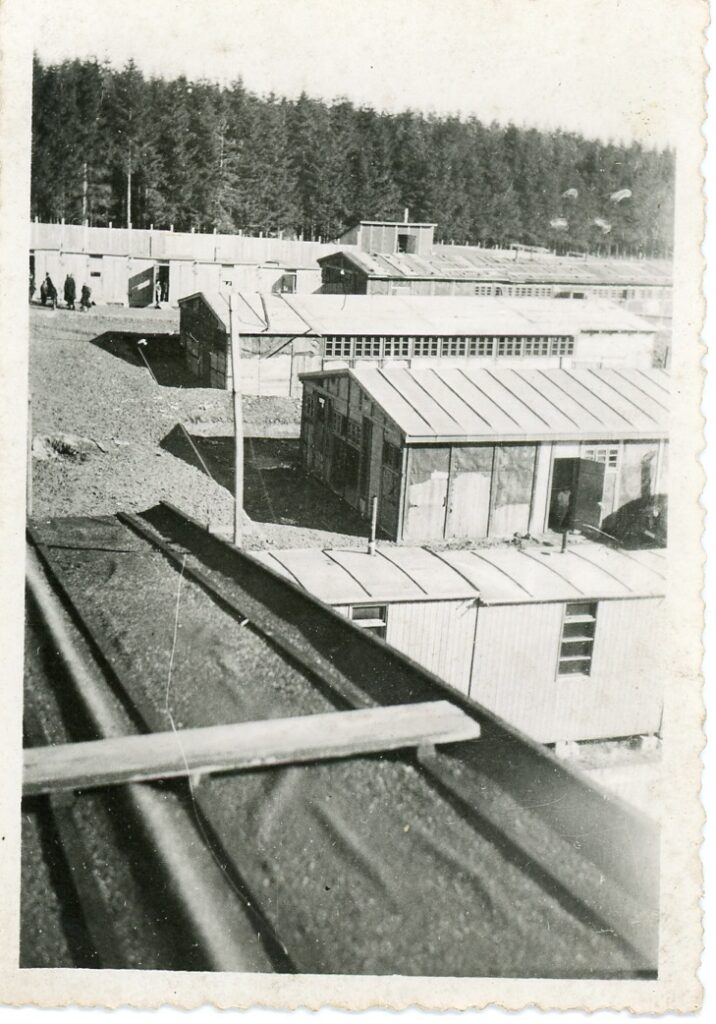
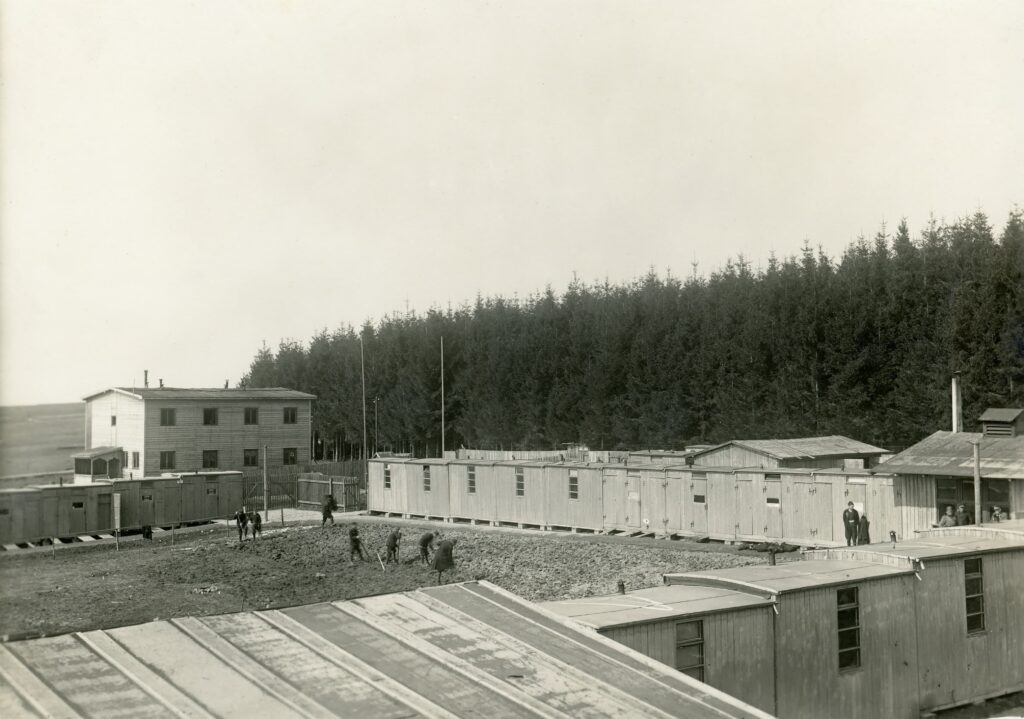
The camp consisted of barracks for the prisoners. These were provisional, non-insulated wooden mobile huts without foundations, which were freezing cold in the winter and unbearably hot in the summer. The camp also included barracks for the guards, technical facilities, an infirmary, etc.
View of the concentration camp in Lety u Písku, residential prisoner barracks no. 51, 52, 53, in the background the fencing and prisoner barracks, from the estate of František Partl, then a guard in the Lety u Písku camp, 1943, Lety, from the MRC collection, MRK F 1/2018/26.
Prisoners probably working on the construction of new barracks for children (see the photograph on the left). In the background, the guards’ barrack can be seen, 1942/1943. From the estate of František Kánský, then a guard in the Lety u Písku camp, 1942. From the MRC collection, MRK F 1/2018/30.
The prisoners were children, women, and men, including elderly people and pregnant women. Children under 14 years of age made up approximately half of all imprisoned persons. One barrack intended for 4–6 persons, was often occupied by 10–17 people at the same time. Women and men lived separately, as did children from the age of two. Younger children could remain with their mothers, who had to take them with them even to forced labour. There was only one well in the camp, which was absolutely insufficient in capacity. Poor hygienic conditions, hard work, and at least triple overcrowding of the camp led to the spread of contagious diseases, including typhus.