Cemetary Mirovice
From August 1942 to January 1943, dead prisoners were buried at the cemetery in Mirovice, by the cemetery wall, in the place reserved for unbelievers and suicides. Altogether, approximately 174 victims, mostly children, are buried here. Today there are memorial plaques with the names of the murdered Roma and Sinti and the sculpture group Romani Mother.
Train station Mirovice
At the railway station in Mirovice, the trains bringing prisoners to the concentration camp in Lety u Písku ended in 1942. From this station, the trains were also dispatched which, in two transports, in December 1942 and May 1943, carried the Lety prisoners to the concentration camp Auschwitz I and later also to the extermination camp Auschwitz II–Birkenau.
Concentration camp in Hodonín u Kunštátu
The camp in Lety was intended for Roma and Sinti from Bohemia and their mixed-bloods, and to a lesser extent also for persons so-called living in a Gypsy manner of life; a similar camp was opened at the same time near the village of Hodonín u Kunštátu for Roma and Sinti from Moravia. The camp in Hodonín was opened on 2 August 1942 and at least 1396 women, children, and men were imprisoned there in total. Approximately 207 of them died in the camp as a result of diseases, hard labour, malnutrition, and cruel treatment by the guards.
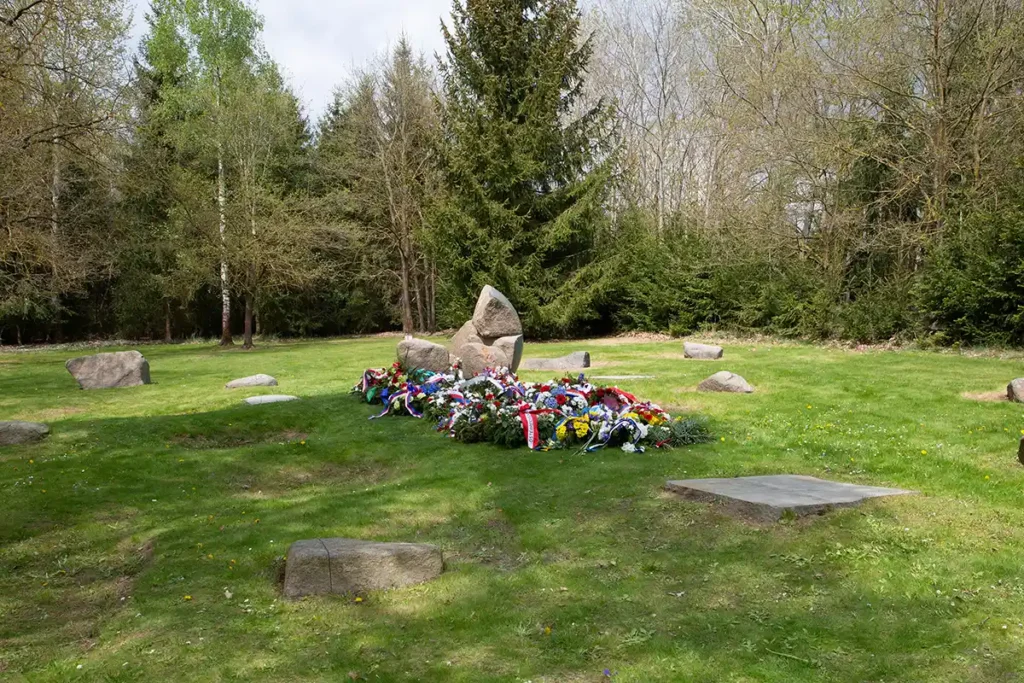
View of the monument by sculptor Zdeněk Hůla at the site of the emergency burial ground. Photo by the MRC: Vladimír Kiva Novotný.
Pond Lipeš The pond was located near the concentration camp. The guards drove the prisoners into the pond for the purpose of cleansing, as there was only one functioning well in the camp and the camp suffered from a lack of water.
Emergency graveyard At the end of 1942, a typhus epidemic broke out in the camp, which caused a high mortality of prisoners, especially children. From mid-January 1943, burial at the Mirovice cemetery was forbidden and an emergency burial site was established approximately 300 m from the camp in the forest. Here approximately 120 prisoners were buried, of whom 77 were children under 14 years of age. At the site there is today a stone monument by the academic sculptor Zdeněk Hůla. The place is today a cultural monument.
Stone quarry All prisoners, including children from the age of 10, were forced to work. The work lasted 10–12 hours a day, six days a week. Women and children worked in the nearby quarry where they crushed gravel. Men broke stone in the nearby quarry, extracted sand, carried out excavation work, worked at detached workplaces – in the forest after windthrows or on nearby farms.